News
January 6, 2026
Seychelles HE taps into the power of regional partnerships
The higher education system of Africa’s least populous country – the Indian Ocean archipelago of Seychelles – is increasingly reaching out to universities in other African countries in order to expand its educational offerings, strengthen its competitiveness and attract more students.
Despite the fact that the 49-year-old country, with 115 islands and only 121,354 people, has the best education system in Africa, according to the World Population Review, it has only one university: the public University of Seychelles (UniSey).
That said, it also has 11 non-university tertiary education and training institutions, such as the Seychelles Institute of Technology and the National Institute of Health and Social Studies.
Partnership with UK university
UniSey, currently with 358 students, was launched in 2009, aided by the University of London, which partnered with the institution to develop curricula.
“The [University of] London’s courses really helped us to establish ourselves as a university and [helped] our lecturers to learn to develop the curriculum at the level of degree courses. After we stopped [our relationship] with London, we developed our own programmes,” Joëlle Perreau, vice-chancellor of UniSey, told University World News.
Initially, in 2009, the University of London provided course texts, set and marked examinations, while UniSey taught the courses and managed student admissions, with London making final admissions rulings. Later, UniSey developed its own programmes, for example, in law. In 2022 those courses evolved into UniSey’s own Bachelor of Laws (LLB), aided by the Seychelles judicial system.
“This was a wonderful project because everybody was involved, and now we have our own local LLB that better suits the judicial system that we have in Seychelles … which is more similar to the Mauritian law system,” said the vice-chancellor.
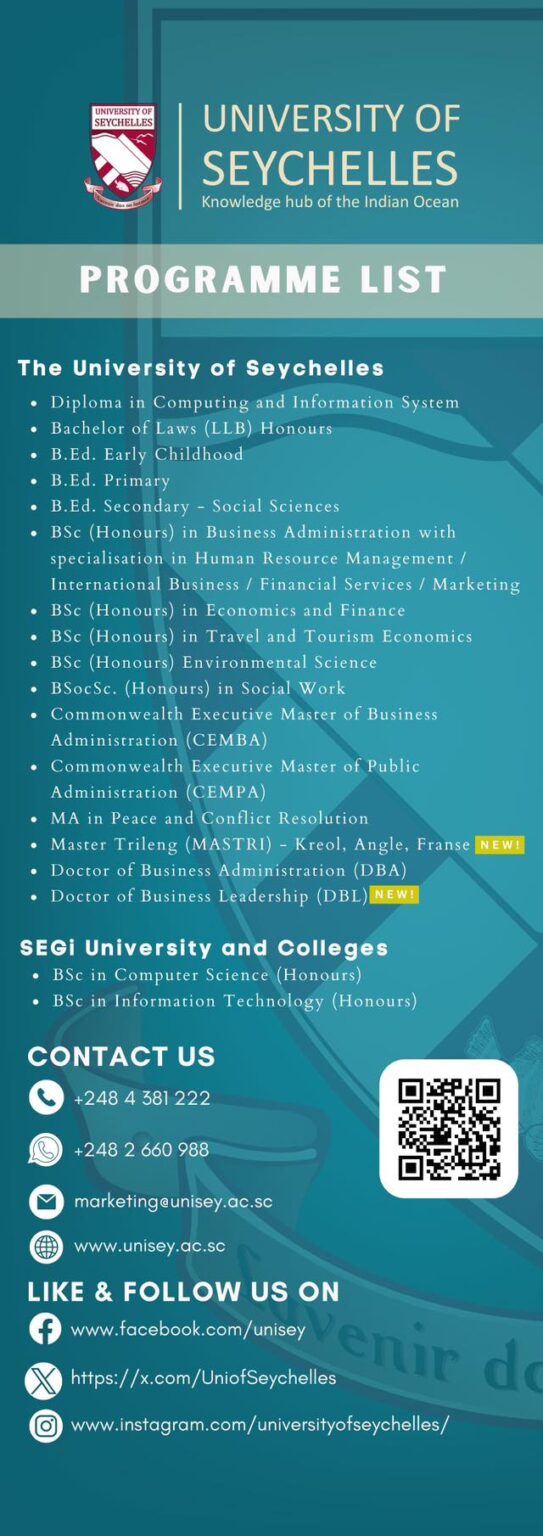
Today, the university offers 13 of its own bachelor degrees, four masters degrees and two PhDs in business administration and business leadership.
“We are also working on a PhD by research on the environment, which is a niche area. And, hopefully, after having this framework validated by the Seychelles Qualifications Authority, we will then continue with other areas – for example, languages, education, even health and social care,” said Perreau.
Such PhDs will help workers advance their studies, sometimes upon the request of the organisations they work for, without the need to leave their jobs and the country, she explained, adding that there are many in-service students in Seychelles adding theory to their work experience.
Open to opportunities
However, given Seychelles’ small population, cooperation is still important. Since the initial collaboration with the English university, the whole objective of UniSey has been to boost cooperation agreements, said Perreau.
“The partnerships are mainly to give us more opportunity for training, for teaching and learning through universities that have more possibilities and more experience than we have.”
Furthermore, she said, such partnerships offer students international exposure, and allow them to study abroad for one year, instead of taking a whole degree in another country. In that way, the country avoids more brain drain.
Since 2010, UniSey has been cooperating with the public University of Réunion, located in the French overseas region of Réunion, also in the Indian Ocean, helping the Seychellois institution offer its students a Bachelor of Arts in French.
At present, UniSey counts 16 active memoranda of understanding with other higher education entities, and a few more are approaching finalisation.
UniSey offers two bachelor degrees in information technology and computer science linked to Malaysia’s SEGi University, and a bachelor of science degree in food safety and environmental health as well as a masters degree in educational leadership linked to the University of Mauritius (UoM).
The agreement signed with UoM in 2012 has enabled UniSey to train 28 Seychellois (since 2021), according to the University of Seychelles.
Perreau stressed that this collaboration boosts local development because the Seychelles Public Health Authority worked with academics to review the modules of the programmes. “And working with Mauritius, the authorities here could ask for specific things they would like to be incorporated in the training,” she said, adding that UniSey is discussing further deals with the Mauritians, including around IT programmes, since their education systems are similar, and English is an official language in both nations.
UniSey is also trying to take advantage of local strengths. For instance, it is trying to leverage its reputation as a peaceful country in the region and its capacity for proactive diplomacy in order to attract international students for peace studies courses.
In 2011, the Seychelles government helped to mediate between parties in a three-year political crisis in Madagascar, sparking a peace deal in September of that year. As a result of that experience and after receiving help from South Africa’s Durban University of Technology, UniSey launched its own masters in peace and conflict resolution during 2022.
Africa partnerships
Meanwhile, UniSey, whose chancellor is Seychelles’ President Wavel Ramkalawan, is also trying to extend partnerships with Ghanaian universities, following long-term political ties between the two countries.
In March (2025), a delegation from UniSey visited four institutions in Ghana – the Kwame Nkrumah University of Science and Technology (KNUST); the Central University (CU); the University of Education, Winneba; and the University of Cape Coast.
Perreau said that a memorandum of understanding, or MoU, with KNUST signed in January 2025 aims to promote staff and student exchanges, collaborative research and training for Seychellois in both countries, probably in IT, since UniSey has just opened a Centre for Innovation and a Centre for Open Lifelong Learning.
“The universities we visited there [in Ghana] were very helpful … with innovation, with artificial intelligence, and so on. They are very much advanced,” argued Perreau, noting that both African and European universities have proved helpful in developing UniSey.
Dr Kingsford Kissi Mireku, the head of Ghana’s CU international programmes office, told University World News the collaboration, based on mutual capacity-building and knowledge exchange, is part of CU’s broader internationalisation strategy to deepen academic ties across Africa.
He added that the partnership, while still in its preliminary stages, is expected to focus on joint research projects, student and faculty mobility, including short-term exchanges and collaborative teaching, and curriculum development and institutional strengthening, particularly in administrative and financial systems.
CU anticipates the initial phase will involve 10 to 15 students participating in exchange or internship programmes and five to eight faculty and administrative staff engaging in joint activities or training visits, said Mireku.
“Cooperation is important to Central University, not only for its academic value, but also for its symbolic significance, as it strengthens South-South collaboration and showcases African-led innovation in higher education,” he said.
Perreau also hopes UniSey will sign agreements with Kenyan universities, including Egerton University, in 2026, following contacts developed by Seychelles Minister of Agriculture, Climate Change and Environment Flavien P Joubert.
“We can’t just go and sign [agreements] with anybody. We need to make sure the ministry, the companies … also have a say in the university we choose because we are very small and we have limited resources here at the university, but also, we have limited numbers of potential students,” she said, while also stressing that UniSey hopes to attract foreign students by expanding its study options.
Since 2014, Seychelles has been sending students and teachers to the University of Botswana to be trained and who then return to assume leadership roles in education services and in the government.
Peter Kwasi Kodjie, secretary-general of the Accra, Ghana-based All-Africa Students Union, which represents more than 170 million students from over 80 national student unions in Africa and in the diaspora, told University World News that the increasing cooperation between Seychellois and other African universities is strengthening competitiveness, both nationally and continent-wide.
“These partnerships help Seychelles integrate more fully into the African knowledge economy. They allow Seychelles to contribute its unique strengths in fields such as marine science and climate change adaptation, while simultaneously drawing from the scale and research depth of larger African institutions,” he said.
Kodjie said such collaboration can also boost research. For instance, UniSey’s James Michel Blue Economy Research Institute, established in 2015, opened pathways for Seychellois academics to engage in research linked to the national priorities of sustainable ocean governance, biodiversity and climate resilience.
Challenges of a small island state
Indeed, Kodjie said: “Seychelles presents a fascinating case of a small island state that has worked hard to build a domestic higher education system while navigating the structural limitations of size and labour market scope. The country has made notable progress through partnerships and investments, but challenges of brain drain, programme breadth and graduate employment remain.”
He warned that such cooperation agreements could bring financial risks and make a small higher education system over-reliant on external partners: “The University of Seychelles could risk being seen as a satellite institution of larger partners, rather than a hub. This could undermine its ability to set an independent academic agenda,” he warned.
Brain drain remains an issue in the country, even with more higher education on offer, and international agreements might encourage students and academics to remain abroad, said Kodjie.
According to the government’s 2024-29 diaspora policy, Seychelles’ diaspora is estimated at between 29,000 and 37,000 people – between a quarter and a third of the resident population.
“For those graduating in specialised fields such as medicine, engineering, ICT, or advanced scientific research, the local market cannot easily absorb their skills. Government statistics reveal that youth unemployment remains consistently higher than the national average, ranging between 8% and 12% [2024 data],” said Kodjie.
This is despite Seychelles having “one of the highest tertiary enrolment ratios in Africa, exceeding 65% in recent years”, said Kodjie, who added that the economy was heavily concentrated in tourism, fisheries and public administration. Kodjie estimated that the total higher education student population is between 2,000 and 2,500.
“Government scholarship figures indicate that, in 2022, the Agency for National Human Resource Development supported 376 Seychellois students abroad and 265 locally,” which, according to Kodjie, despite being vital to create opportunities, also facilitates local brain drain, given that the country’s higher education portfolio remains narrow, with limited postgraduate opportunities and modest research output.
Still, Kodjie noted, local students view higher education with pride and ambition. “Students have consistently praised the personalised teaching approach that comes with small class sizes and the responsiveness of the curriculum to national development priorities, particularly in the fields of the blue economy, environmental science, and ICT,” he added.
The sector welcomed the creation of a Seychelles Qualifications Authority in 2021 to ensure all local programmes are subject to external quality assurance and aligned with international standards.